
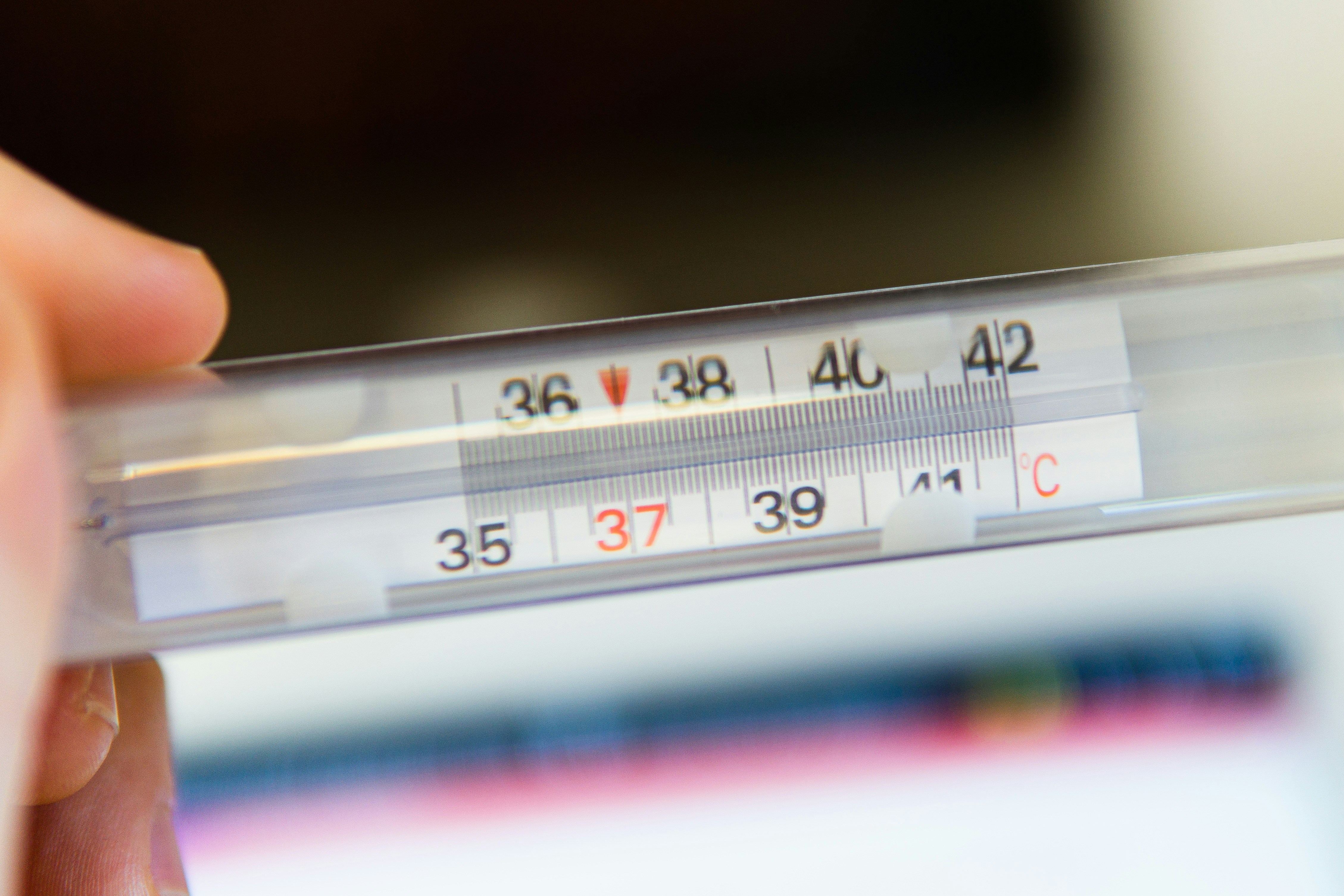
Photo credit:Matteo Fusco/Unsplash
Fever and the Body’s Natural Defence
This week I have been studying fevers as a mechanism of homeostasis (our body’s internal control system that regulates things like temperature, blood pressure, blood sugar, and more).
I always assumed that a fever was the enemy, something that needed to be controlled or eradicated by medication in order to feel better. Fever is a key indicator that something is wrong, but what I didn’t know was that by treating or suppressing a fever, it may take longer to fight off the cause and, conceivably, make you feel worse.
What is a fever?
A fever, pyrexia in medical terms, is a body temperature above what is considered normal.
The familiar figure of 37°C, widely considered to be “normal” body temperature, was established in the 1800s by a German doctor who calculated the average from 25,000 healthy subjects.
In reality, there is no single number that defines normal. Instead, there is a range considered optimal, typically between 36°C and 38°C. A temperature of 38°C or higher is generally considered a fever.
Our body temperature naturally fluctuates throughout the day. For example, it tends to be lower in the morning, higher after exercise, during menstruation, and higher in the evening.
Most of us have no idea what our baseline temperature is on any given day. We usually only start considering the possibility of a fever when something else feels off.
Why does the body create a fever?
When viruses or harmful bacteria enter the body, the immune system responds by raising our temperature. This higher temperature creates an environment that makes it more difficult for viruses or bacteria to replicate.
It activates the first line of defence in our immune system, known as innate immunity, mobilising white blood cells that quickly go to work finding and destroying pathogens.
Fever works alongside other defence systems in the body, synergistically, to help your body ride out the storm.
Medication: Suppression and palliation
Medications such as paracetamol or ibuprofen do not cure infection; they relieve symptoms. You may feel more comfortable after taking them, but by using them to suppress a fever, you may be inhibiting the body’s natural immune response.
In an article in The New York Times, “Why Are We So Afraid of Fevers?”, Dr Paul Offit, a vaccinologist at the University of Pennsylvania, states that “fever enhances survival” because the immune system works more effectively at higher temperatures.
He also advises that allowing a fever to run its natural course can reduce viral shedding (the amount of time you might be contagious) and shorten the duration of illnesses such as flu.
Every time we suppress a fever, we dampen the immune response, which helps explain why we can take longer to recover.
However, the temptation to reach for paracetamol can be difficult to resist. With children, fevers often coincide with distress and, understandably, as a parent, you want to relieve their discomfort — cue Calpol.
With adults living life in the proverbial fast lane, there is often little time to let a fever run its course. People with busy lifestyles and demanding jobs simply need to feel better so they can get back to the grind.
These medications absolutely have a place. Nevertheless, science supports the body’s own defences as a powerful route to recovery and shows us that intervention can sometimes come at a cost.
Not all fevers are equal
There’s always a tipping point where intervention becomes necessary, sometimes critical, and this is where the situation goes beyond the first aid kit.
A fever can raise the pulse and breathing rate, placing additional strain on the heart and lungs. It may also increase the risk of complications in people with underlying medical conditions.
Guidance from the NHS advises seeking medical attention if a child:
- is under 3 months old and has a temperature of 38°C or higher
- is 3 to 6 months old and has a temperature of 39°C or higher
- has other signs of illness, such as a rash
- has a high temperature lasting 5 days or more
- is not eating or behaving as usual
- shows signs of dehydration
If a child develops any of the following symptoms, this should be considered an emergency:
- a stiff neck
- a rash that does not fade when pressed
- sensitivity to light
- a seizure for the first time
- unusually cold hands and feet
- changes in skin colour
- difficulty waking
- extreme agitation or confusion
- difficulty breathing
- not responding normally
For adults, guidance is less specific, but the same warning signs apply. Persistent high temperature, rash, confusion, seizures, breathing difficulty, or worsening symptoms all warrant medical attention.
Be aware of the signal, but trust the system
A fever is an indicator of illness, a warning sign, but in someone who is generally healthy, it is not the enemy.It is evidence that our immune system is working.
Yes, we need to monitor it and take it seriously, but often the best course of action is to give the body what it needs: rest, fluids, and time to do what it was designed to do.
Sources
Centers for Disease Control and Prevention. (n.d.). Viral shedding. ScienceDirect. https://www.sciencedirect.com
National Health Service. (n.d.). High temperature (fever) in children. https://www.nhs.uk
Offit, P. A. (2024, January 8). Why are we so afraid of fevers? The New York Times. https://www.nytimes.com
Romanovsky, A. A. (2007). The fever paradox. Journal of Applied Physiology, 103(1), 6–7. https://www.ncbi.nlm.nih.gov/pmc/